

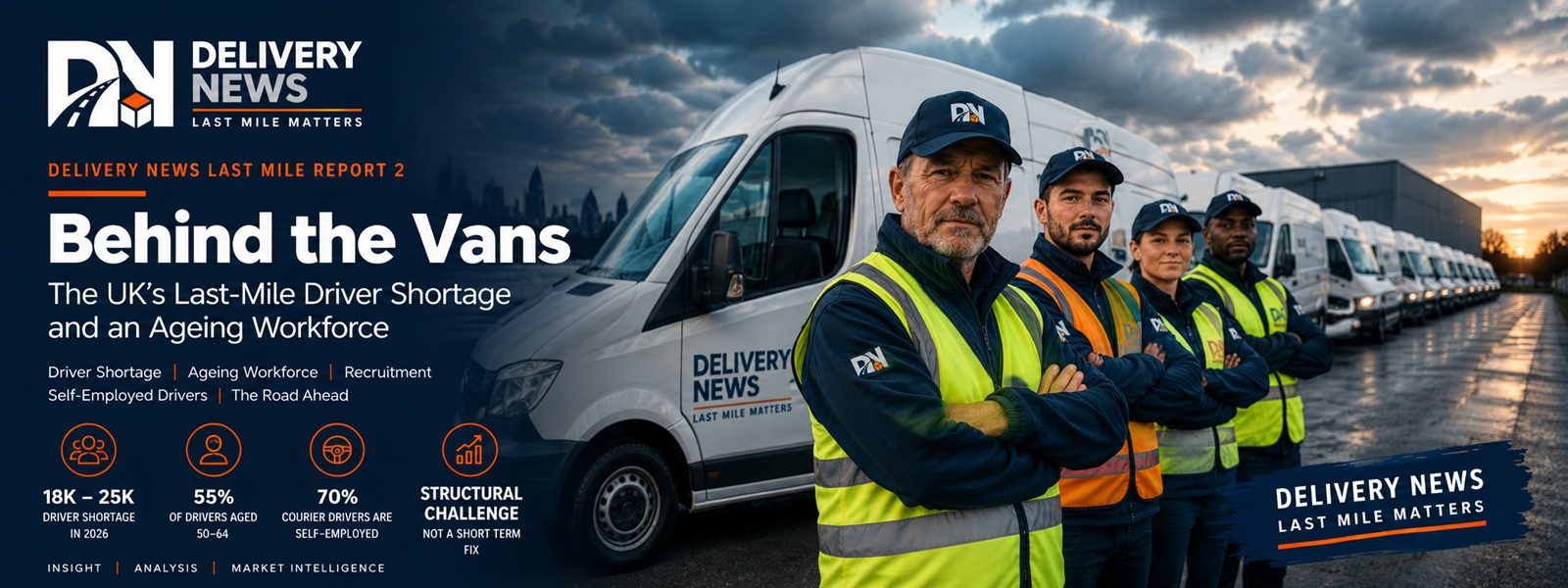
Behind the Vans The UK’s Last-Mile Driver Shortage and an Ageing Workforce
The Workforce Behind the Last Mile
A growing last-mile delivery market depends, ultimately, on a sufficient supply of qualified drivers to move goods on the final leg of the journey.
That supply is under sustained pressure, and the shape of the shortage — as much as its size — has significant implications for how the sector plans its workforce over the next decade.
The Scale of the Shortfall
Current estimates place the UK’s shortage of qualified drivers at approximately 18,000 to 25,000 in 2026.
18K–25K
Estimated qualified-driver shortfall~70K
Approximate early-2020s peak55%
Drivers aged between 50 and 64~70%
Estimated self-employed courier shareThe current shortage represents a meaningful improvement on the peak shortfall of around 70,000 drivers recorded in the early 2020s.
That period was marked by pandemic-related disruption, changes to HGV testing capacity and post-EU exit shifts in the available labour pool. Stronger recruitment pipelines and modernised testing processes have narrowed the gap considerably since that peak.
However, industry bodies including the Road Haulage Association continue to describe the shortage as a structural issue rather than a resolved one.
The reduction from 70,000 to a still-substantial 18,000–25,000 shortfall should therefore be read as progress against a serious crisis, not as evidence that the underlying problem has been fixed.
An Ageing Workforce Compounds the Risk
That concentration means a substantial proportion of the current workforce is within 10 to 15 years of conventional retirement age, with no guarantee that recruitment into the sector will keep pace with the resulting attrition.
This creates a structural risk distinct from the current numerical shortage.
Even if today’s 18,000–25,000 gap were fully closed through recruitment, the sector would still face a wave of retirements over the coming decade that could reopen or widen the gap unless younger drivers are recruited and trained at a matching rate.
The shortage, in other words, is not a static problem to be solved once, but a demographic pipeline issue requiring sustained investment.
Why the Shortage Persists
Several structural factors continue to make driver recruitment and retention difficult across the sector, beyond simple headcount availability.
Entry Requirements & Training Costs
Entry requirements and training costs have historically represented a barrier, although this is one area where recent change is evident. Training is increasingly employer-funded, and many last-mile and van-based roles no longer require previous courier or HGV experience.
A Bifurcated Employment Model
A substantial share of last-mile driving activity operates under self-employed or gig-economy arrangements rather than direct employment, creating a workforce model with very different economics and benefits.
Rising Driver Operating Costs
Self-employed couriers carry their own vehicle, fuel, insurance and maintenance costs. As those costs rise, effective hourly returns narrow and retention can become more difficult.
The Employment Structure of the Sector
This split has implications for how attractive driving roles are perceived relative to traditional employed positions offering holiday pay, sick pay and pension contributions.
It also affects how straightforward it is for operators to plan long-term workforce capacity when a large proportion of drivers are independent contractors rather than employees.
Rising Costs Are Squeezing Self-Employed Driver Economics
Self-employed couriers bear many of the operating costs that would otherwise sit with an employer or fleet operator.
Insurance in particular runs significantly higher for courier and delivery work than for standard personal motoring. As these costs rise, the effective hourly return for self-employed drivers narrows, which can affect retention within the self-employed segment specifically.
What It Means for Operators and Suppliers
Workforce capacity is becoming a strategic operating issue, not simply a recruitment challenge.
For fleet operators, retailers and logistics businesses dependent on last-mile capacity, the workforce data points toward a planning challenge that extends well beyond simple recruitment marketing.
An ageing driver population, a persistent though narrowing shortage, and a workforce split across employed and self-employed models together mean that driver availability, cost and retention will remain live operational issues for the foreseeable future.
The Commercial Takeaway
Workforce capacity may become one of the binding constraints on future last-mile growth.
Businesses serving this sector — whether through recruitment, training, vehicle finance, insurance or fleet technology — are operating against a backdrop where workforce capacity, not just delivery volume, is the constraint many operators are actively managing around.
Next in the Series
Employed vs Self-Employed: The Two-Tier Last-Mile Workforce
The next article in this series examines the two-tier workforce structure directly: how employed roles at major retailers compare with the self-employed and gig-economy models operated by platforms such as Amazon Flex, Evri and DPD, and what that divide means for pay, cost and operational flexibility across the sector.
Connect with the UK’s last-mile delivery market.
Speak to Delivery News about market intelligence, editorial opportunities and reaching decision-makers across the delivery sector.