

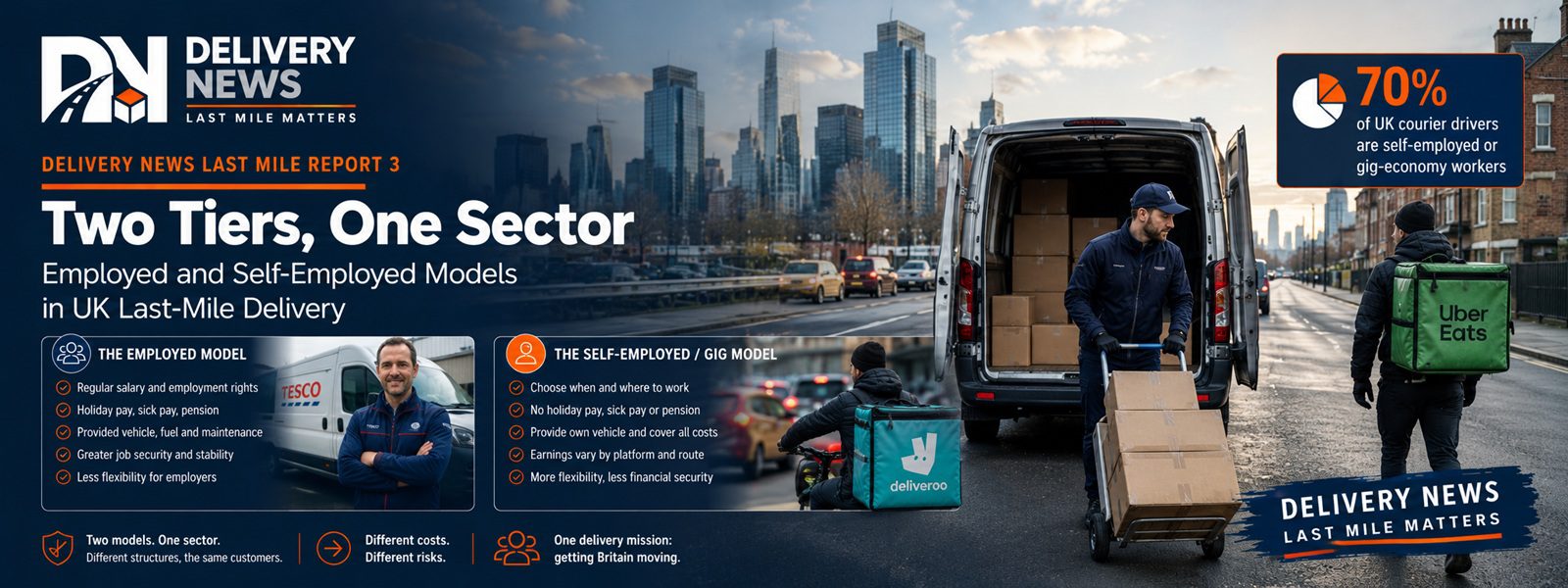
Two Tiers, One Sector Employed and Self-Employed Models in UK Last-Mile Delivery
One Sector, Two Workforce Models
The UK’s last-mile delivery workforce is not a single, uniform labour market.
It operates across two distinct employment structures, running in parallel across the same sector and often serving the same customers. Understanding the practical differences between them — in pay, cost, employment rights and operational flexibility — is essential to understanding how the wider last-mile sector actually functions.
Direct Employment
Drivers are employed by the retailer or logistics operator, with a salary, employment protections and fleet operating costs typically covered by the employer.
Self-Employed & Gig Economy
Drivers work as independent contractors, providing flexible capacity but carrying their own vehicle, fuel, insurance and maintenance costs.
The Employed Model
A number of the UK’s largest retailers and logistics providers continue to employ their delivery drivers directly.
Tesco, Sainsbury’s, Asda, Ocado and Royal Mail typically fall into this category, alongside a proportion of DPD and DHL delivery activity, even though both of the latter also operate substantial owner-driver fleets alongside employed staff.
Employed roles generally carry the standard protections associated with direct employment: holiday pay, typically a statutory minimum of 28 days, sick pay, pension contributions, and a provided vehicle with fuel and maintenance covered by the employer.
£22K–£30K
Reported annual salary range£28K–£36K
Reported annual salary range£35K–£45K+
Reported annual salary rangeThe trade-off for the employer is reduced flexibility. Employed drivers represent a fixed labour cost regardless of delivery volume fluctuations, and scaling capacity up or down in response to demand — a Q4 peak, for example — is comparatively slower and more expensive than in a contractor-based model.
The Self-Employed and Gig-Economy Model
The alternative structure, used extensively by platforms including Amazon Flex, Evri, Uber Eats, Deliveroo, and a significant proportion of DPD’s owner-driver franchise network, engages drivers as independent contractors rather than employees.
Under this model, drivers supply their own vehicle, absorb their own fuel, insurance and maintenance costs, and carry no entitlement to statutory sick pay, holiday pay or pension contributions.
In exchange, they retain full control over which delivery blocks or routes they accept and when they work.
£12–£25
Typical reported hourly range£8–£14
Approximate hourly return after operating costsReported gross earnings for self-employed couriers typically fall in the range of £12 to £25 per hour, though this figure requires careful interpretation.
After accounting for fuel, insurance, vehicle depreciation and maintenance, net earnings for many self-employed drivers fall to approximately £8 to £14 per hour — substantially below the headline gross figure, and in some cases close to or below effective minimum wage once true costs are accounted for.
Insurance costs are a particularly significant factor in this calculation. Commercial hire-and-reward cover for courier work runs meaningfully higher than standard personal motor insurance and represents one of the largest fixed costs a self-employed driver carries regardless of how many hours they work.
Payment Structures Vary Across the Gig Economy
Payment structures within the self-employed tier also vary by platform.
Some, including Evri, pay per parcel rather than per hour, meaning driver earnings are directly tied to route density and delivery efficiency.
An experienced courier familiar with their round can deliver significantly more parcels per hour than a new starter, creating a wide earnings range even within the same role at the same company.
Why the Split Exists — and Persists
The coexistence of these two models is not incidental; it reflects genuinely different operational needs across the sector.
Why Retailers Favour Employment
Retailers with predictable, recurring delivery volumes — a weekly grocery shop, for example — have historically favoured employed models that offer consistency, brand control and service reliability.
Why Platforms Favour Contractors
Platforms managing demand-spiking volumes — parcel delivery around online sales events, or food delivery around meal times — benefit from contractor models that let capacity expand and contract without the fixed cost of a larger permanent workforce.
The Self-Employed Tier Has Become Central to Capacity
That figure underlines how central the model has become to the sector’s ability to absorb variable demand, even as it raises ongoing questions — actively debated between industry and worker representative groups — about income stability and access to standard employment protections for a large share of the delivery workforce.
What This Means for the Wider Sector
The two-tier workforce model shapes buying behaviour directly.
For businesses supplying insurance, vehicle finance, fuel, telematics or compliance services into the last-mile sector, this two-tier structure is not a peripheral detail.
Centralised Fleet Procurement
Employed-model operators typically buy fleet-level insurance, vehicles, telematics, fuel and compliance solutions through centralised procurement.
Individual Driver Purchasing
Self-employed drivers buy as individuals, are often highly price-sensitive and are directly exposed to the cost of insurance, vehicle finance and fuel.
The Commercial Takeaway
The same last-mile market contains two very different customer groups.
A fleet operator purchasing centrally and an independent courier purchasing personally may ultimately perform similar delivery work, but the way they evaluate insurance, vehicles, fuel, technology and compliance is fundamentally different. For suppliers, recognising which workforce tier they are targeting is therefore critical to product positioning, pricing and customer acquisition.
Next in the Series
Inside Amazon’s Delivery Service Partner Model
The next article in this series looks specifically at Amazon’s Delivery Service Partner model — a structure that sits distinctly between direct employment and individual gig work — and examines what it means for last-mile capacity across the UK.
Connect with the UK’s last-mile delivery market.
Speak to Delivery News about market intelligence, editorial opportunities and reaching decision-makers across the delivery sector.